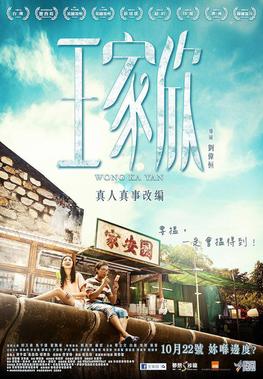
Plot
The story is set in 1992. The protagonist Chun Yin, who lives in Peng
Chau (坪洲),
is a guitar enthusiast and loves composition. One day, he goes to downtown and
watches a movie. There he meets a box office girl and he immediately fell for
her. The only thing he knows about the girl is her name, which is shown on her
name tag – Wong Ka Yan. Chun Yin tries as hard as he could to find that girl,
he uses “Yellow Pages” and calls every “Wong” family phone number to reach for
her. During investigating, Chun Yin encounters another girl named Wong Ka Yan.
At first, Wong despises Chun Yin. But later on, Wong is moved by Chun Yin’s
persistence and thus she helps Chun Yin to find his dream girl. And ironically,
She couldn’t help herself to fell for Chun Yin…
Symbolization
The setting of story is in 1992, the time before Hong Kong’s
reunification with China. Chun Yin lives in Peng Chau, which is a small island
miles away from busy city. Chun Yin always behaves like a carefree young adult.
All he wants to do are just play guitar and sing ballad.
In my opinion, Chun Yin represents most of the Hong Kong citizens at
that moment. In 1992, Hongkongers realize that after 5 years, Hong Kong will be
taken under Chinese Communist Party’s governance. Some Hongkongers may try to
migrate to Western countries; for those who can’t leave, they may have a
carefree attitude, in order words, to enjoy while they can. Besides, Peng Chau
is a small quiet beautiful island in Hong Kong, it symbolizes Hong Kong itself before
1997, it is like an ideal paradise for all. What is more, Chun Yin’s sister
owns a Dai Pai Dong (大排檔),
it is called Ka On Yuen (家安園).
In Chinese, it means “family is safe and sound”. From the protagonist’s
character to the location and the name of food stall, it is obvious that the
director has certain intention to use this story to represent the circumstances
of Hong Kong citizens and Hong Kong itself in pre-1997 stage. However, when
Chun Yin goes find his dream girl, his encounter with different “Wong Ka Yan”
may involve other underlying representation and symbolization.
Nostalgia in pre-1997
Throughout the film, audience
can discover numerous props from the 90s. First, the theater that Chun Yin goes
to is called “豪華戲院”,
a classic old theater in Hong Kong. In fact, Chun Yin watches a category III
film in that theater. It also reveals that decades ago Hong Kong cinemas are
used to show adult movies. Moreover, there is a scene that Wan Kwong (尹光)
featuring as guest appearance. He sings one of his famous song <荷里活大酒店>,
it highlights the golden days of Wan Kwong in 70s to 90s. Likewise, it is easy
to spot people using call machine instead of mobile phone. These props are
presenting a typical nostalgic Hong Kong, which nowadays many people consider
as the good old days of British Hong Kong.
What does “Wong Ka Yan” actually
mean?
While Chun Yin use “Yellow Pages” to find his dream girl, he
surprisingly finds lots of people sharing the same name – Wong Ka Yan. One of
the Wong-Ka-Yans (starred by Karena Ng) becomes friends with Chun Yin and helps
him find his dream girl. As story heads to the finishing line, Karena reveals a
cruel truth to Chun Yin that the name of that girl is Wong On Yan (王安欣)
instead of Wong Ka Yan. Like a thunder from a clear sky, Chun Yin collapses.
Karena expresses her affection to Chun Yin but he thinks the box office girl
“Wong Ka Yan” is his real love, therefore he turns down Karena’s courtship.
Apparently, the genre of this film is love and romance. However, the
name “Wong Ka Yan” is so common in the film and so in reality I believe, which
leads me to deduce that “Wong Ka Yan” can be a symbol as well. It can represent
your goal, target, dream, or even your political philosophy. One and a half
year ago, Hong Kong underwent Umbrella Revolution, a series of street protests
lasted for 3 months. Millions of Hongkongers are sharing one belief - long for
true universal suffrage. Although the outcome is disappointing, like the
conclusion of this film, however, Chun Yin gets to know different Wong Ka Yans
during his searching. At the end of the film, Karena gathers all Wong Ka Yan
and hold a thanksgiving party to Chun Yin. He loses a potential lover but gains
lots of friendship. As a participant of the Umbrella Revolution, regarding to
the outcome, it is a failure. However, Hongkongers learn a precious lesson and
it ignites the torch of younger generation to search for democratization. The
political mind of Hongkongers has been revived.
Conclusion
All in all, this film did pretty well to recreate the pre-1997 Hong
Kong. There are lots of symbolization and underlying representation of
the film. More importantly, I think the director wants to take this story to
encourage audience that you can’t have it all in life, yet sometimes the
process of searching is much more rewarding than the result. Like the answer
from Chun Yin to reply Karena’s question: When will you stop finding her?
“Until I find her.”
word count: 919
Reference:
Ahmad, A. (2006). Jameson’s Rhetoric of
Otherness and the “National Allegory”. In B. Aschcroft, G. Griffiths & H.
Tiffin (eds.). The Post-Colonial Studies Reader (2nd ed.). (pp.84-88). Oxford: Routledge.
Chandler, D. (1997). Introduction to
genre theory. Retrieved from http://www.aber.ac.uk/media/Documents/intgenre/chandler_genre_theory.pdf
Hall, S. (2000.) Encoding/Decoding. In P.
Marris & S. Thornham (eds.). Media Studies: A Reader.
(pp.51-61). Washington Square, N.Y.: New York University Press.
Student Name: Lee Ka Kin, David
Student Number: 10620210/21620685

Dear David, Your reading of the selected film is interesting though there may be a little over-read regarding the identity of Hong Kong as implicated in the film. However, the reading means that you can go beyond the mere description of the story. Theoretical concepts are properly referenced. The writing exceeds the word requirement of 500 words. To be fair to other students who only express their ideas in shorter article, my marking will not take the last two paragraphs into account.
回覆刪除