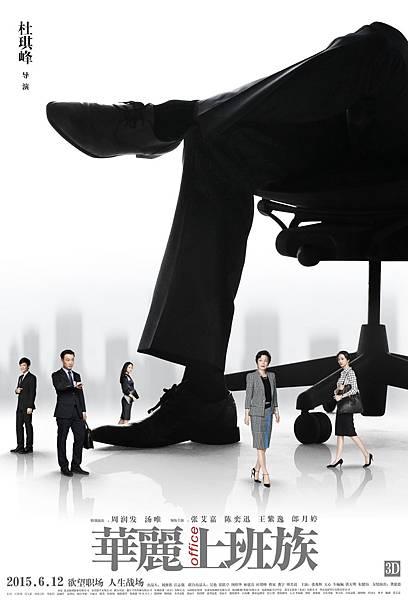
Office (華麗上班族) is a Chinese
musical movie, which is a really rare movie type in mandarin speaking region,
released on the 24th September 2015 in Hong Kong. This film was
produced and produced by Johnnie To, and the story was adapted from a living
theatre play Design for Living (華麗上班族之生活與生存) which was created by Sylvia
Chang. The movie plot is around three classes of business officers, who are
using different ways to reach their living goals. The story starts from the
first working day of Lee Seung (Wang ZIyi), a new employee of the Jones &
Sunn Company. The story was told with Lee’s youthful ideals and dream towards
the future and society. It is offering audience a strong comparison with the
complicated relationship and waves of power wrestling inside the office.
The genre of this film is musical comedy; however the comedy elements
are not the main outcome of the movie. It brings out and enlarges some ideologies
in the Hong Kong society, which successfully makes audience, put themselves
into the characters, connect to the theme and reflect one’s living goal. In
this way, comedy elements play minor effect in adjusting the whole atmosphere. In
the main plot, there are three “couples”, they represents three classes in the
society and at the same time describing the complicated social relation in
between.
The
setting of this musical is rather special and interesting. The iconic signs of
the Hong Kong MTR and the habits of going to work remind audience the story is
inspired by Hong Kong. The film mentioned about the financial crisis,
increasing investment of China and declining business power of the west also
play the same role. Those ‘form of appearance’ make the movie stay close to the
realistic life, which make audience accept and understand the messages from the
film more easily. (Hall, 2000) However, the setting is a soaring open-plan set
to embrace the living theatre origins. In contraries, this special element also
remains viewers that the plot is a fiction.
The company chairman Ho Chung-ping (Chow Yun-fat) and CEO Winnie
Cheung (Sylvia Chang) as the upper class of the office, take the adventures of
each other to make their own benefits. David Wong (Eason Chan) and Tang Wei (Sophie)
as the middle class of the office, while David only works hard for money to
remain middle class living style, and even act opposite to the moral value when
he is facing financial crisis . On the other hand, Sophie endures homesick and
working pressures to make a better living. Lee Seung as the new hire of the company
has the enthusiastic in performing himself, just because of reaching his dream.
Most of the officers reserves most of their thought, which makes him able to
keep his benefits. The iconography of the characters’ setting creates a
familiar mood and tone to the salarymen, who are most of the viewers at the
same time, fit in the text-reader relationships. (Chandler, 1997)
References
Chandler, D. (1997). Introduction to genre
theory. Retrieved from http://www.aber.ac.uk/media/Documents/intgenre/chandler_genre_theory.pdf
Hall, S. (2000.) Encoding/Decoding. In P.
Marris & S. Thornham (eds.). Media Studies: A Reader. (pp.51-61).
Washington Square, N.Y.: New York University Press.
Ho Ka Wing, Karen 10613360, 21621574

Dear Karen, The theme of your review is easily understood. In fact, the organisation of your arguments is fine. The weakness is the materials quoted from other references. The "quoted" sentence does not always make sense to the reader. This gives an impression that the line is quoted for the sake of being quoted only. A case in point is the last sentence. By text-reader relationship, Chandler aims to point out that people can recognise what kind of films that is to be shown. Now the quote is out of place. It would just make the reader confused.
回覆刪除