
Source:
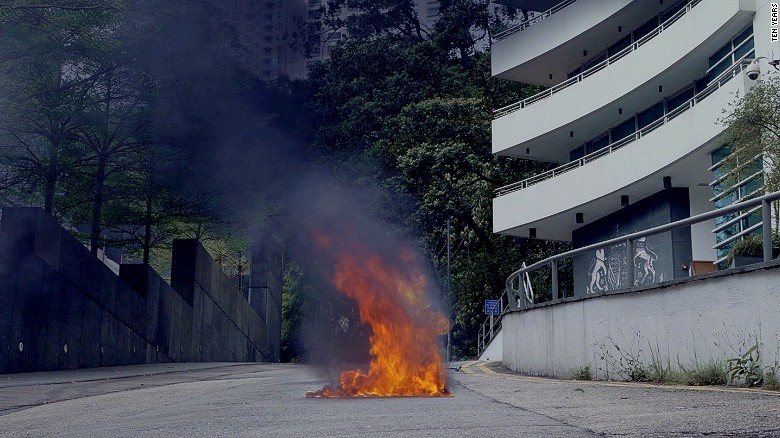
https://www.hongkongfp.com/wp-content/uploads/2016/02/bab007cf-89c8-402c-b56d-275b9d1be954.jpg
Ten Years
(Chinese: 十年) is a dystopian
film dedicated to address socio-political changes of Hong Kong by the year of
2025. The film is arranged in a form of non-linear storytelling that consists
of five independently-directed stories, namely Extras, Season of the End,
Dialect, Self-immolator and Local Egg. Each of these modular scenarios projects
and explores the possible outcomes of social, political and cultural discourses
in contrast to the surging political intervention from China: be it the influx
of Putonghua, the downfall of local cultures or the exacerbating suppression of
freedoms by the government. Nonetheless, the popularity of the film, which hits
$6 million box office earnings by mid-February (“Ten Years”, 2015),
is largely coupled with the concept of “collective memory”; that is, a mutually-approved,
fragmented remembrance that carries the past events to the present (Storey,
2003). By articulating the meanings encoded in the media texts, a distinctive cultural
identity is produced and reconfirmed which delivers a sense of resonance to the
audiences as they relate the good memories in the past to those of the present
(Hall, 2000).

The story
“Dialect” (directed by Jevons Au) takes place in an imaginary framework of the
year 2025. The major narration rotates around the struggling livelihood of a
taxi driver “Ah Hon” (阿漢), who is not
qualified in the Mandarin proficiency test. Nevertheless, the contrast between “Ah
Hon” and his son “Kongson” (港生), so as other proficient
Putonghua speakers has encoded the messages of “Cantonese being marginalized by
Putonghua” and “Putonghua is more superior than Cantonese”. The consumption of
these hidden messages will thus produce a strong binary
comparison between a “Chinese” and a “Hong Konger” to the audiences; given the
fact that Putonghua is widely perceived as a symbol of the Mainland Chinese
culture, while the latter has always been seen as one of the “core cultural
values” of Hong Kong.


Another
example is the “Self-immolator” (directed by Chow Kwun-wai), a short parody
that pays close attention to the desperate resistance of Hong Kong people,
specifically when their concerns are not entertained due to the prevalence of “political
correctness” within the society. Speaking in the audiences’ shoes, the scenes
of self-immolation by both youngster and elderly have delivered a strong
sentiment of despair which can be easily associated to the gloomy future of both
Tibet and Hong Kong, due to the dissatisfaction with the status quo (Halbwachs,
1992). On the other hand, the repetitive scenes of police
deploying tear gas and beating up protesters also help audiences to articulate back
to their bases of knowledge (Hall, 2000), presumably the outbreak of Umbrella Revolution
in 2014.
Ten Years
is a form of memory industry and a site of memory. As Storey (2003) suggested,
it allows audiences of similar social contexts to revisit the past memories by
means of representational production. After all the successful delivery of
resonance, as well as the creation of cultural identity are the major
contributors of success to this film.
Reference:
Halbwachs, M. (1992). (Ed. & translated
by Coser. L.A.) Chapter 1-4. On Collective
Memory. (pp.41-53). Chicago: The University of Chicago Press.
Hall, S. (2000.) Encoding/Decoding. In P.
Marris & S. Thornham (eds.). Media
Studies:
A Reader. (pp.51-61). Washington Square, N.Y.: New
York University Press.
Storey, J. (2003).
Popular Culture as the “Roots” and “Routes” of Cultural Identities. In Inventing Popular Culture. (pp.78-91). Malden Mass: Blackwell.
Ten
Years (2015). (n.d.). Retrieved April 14, 2016, from http://www.boxofficemojo.com/movies/intl/?id=_fTENYEARS201
Wilton Chau (10489058/21620326)



Dear Wilton, This is a very nice piece of work. The analysis is professional with the use of appropriate concepts learnt in class. The organisation of the thoughtful arguments impresses the reader. In fact, it is not easy to write up a review of "Ten Years" as it could turn out to be a very straightforward summary of the episodes. But you go beyond this and articulate the film to the social context reasonably. Keep up the good work!
回覆刪除